
Anthropic priced its initial public offering at $83 per share on 18 November 2026. The announcement sets out the terms of the offering. It announces no new Claude model, API price or customer term. For business buyers, the practical change is a new stream of public filings that can inform supplier due diligence.
A Hungarian company with five to fifty employees does not need to alter its Claude deployment this month because of the IPO. A review is worthwhile where a production workflow depends on one provider and replacing the model would require substantial engineering. At Leventech, we recommend keeping the model replaceable through one API layer, pinned model versions, a fallback to a second provider and an evaluation set built from your own Hungarian cases.
The final price exceeded the earlier range
Anthropic’s 18 November announcement sets the offering at 980,000,000 shares and $83 per share. The company expected ANT shares to begin trading on the Nasdaq Global Select Market on 19 November. It expected the offering to close on 20 November, subject to customary closing conditions.
The earlier roadshow announcement, dated 10 November, proposed a range of $70 to $78 and an offering of 825,000,000 shares. Calculated from the disclosed figures, the final price is 6.41% above the top of that range. The number of offered shares increased by 18.79%. These figures describe demand for the offering; they do not indicate future API prices or Claude’s product roadmap.
SEC filings can support supplier monitoring
Anthropic announced on 26 October that it had filed an S-1 registration statement with the US Securities and Exchange Commission. The 18 November announcement says the SEC declared the registration statement effective on that date.
Procurement teams can now monitor three channels for different purposes. Product announcements cover models and availability. Customer notices cover contractual and data-processing changes. Financial and risk disclosures in later SEC filings can add evidence to supplier due diligence.
A securities filing does not itself amend an API contract, so direct customer communications still require separate monitoring. Reopen the procurement decision after a dated announcement about API pricing, model availability or customer terms. A change to retention, EU-region processing or the data processing agreement should trigger the same review.
Before renewing a material supplier contract, compare product and customer notices with the latest public company filings. Share-price movements are not a procurement metric. The relevant questions remain service price, quality, data handling and the cost of replacing the provider.
Your integration determines the cost of migration
Vendor dependence becomes expensive when provider-specific components spread through a workflow. If prompts, tool calls, error handling and business rules are tied directly to one Claude model, a later migration requires engineering and a full evaluation. A common API layer and pinned model versions can reduce the change to a narrower technical update followed by a controlled rerun of the evaluation set.
Hungarian-language cases require a separate evaluation. English-language benchmarks do not establish performance on Hungarian accented characters, company-name formats or document structures. For workflows that extract names, dates and amounts from customer emails, invoices and contracts, use 30 to 50 real cases from your own operations. Apply the same acceptance criteria to every candidate model.
The model fee is only one cost component. Cost per accepted result also includes human correction, failed runs and operation of the integration. Migration is justified when the same cases show a lower cost per accepted result at the required quality threshold.
The guide to choosing a proprietary enterprise AI model compares pricing, context windows and data handling. If Claude is already in use, the Claude Fable 5.2 migration guide covers how to measure migration costs on Hungarian-language tasks.
Enterprise AI can connect to your existing systems while keeping the underlying model replaceable. Enterprise AI solutions
Your current Claude setup determines the action
| Current situation | Action now | Reason |
|---|---|---|
| A production workflow runs on one Claude model | Inventory provider-specific prompts, tool calls and error handling; configure a fallback to another provider. | This reduces engineering work if pricing or terms change later. |
| Claude is supplied through a SaaS platform or reseller | Ask who owns model migration, data-processing terms and customer notification. | The intermediary contract determines how a provider change reaches you. |
| A Claude pilot is being prepared | Include a second provider in the same 30-to-50-case evaluation. | It is easier to establish the fallback during a pilot than after production launch. |
| A common API layer, fallback and evaluation set already exist | Keep the current model and monitor dated product, pricing and customer-term announcements. | Existing controls allow a later change to be evaluated quickly. |
| Claude is not in use, or no production AI workflow exists yet | Do not start a separate procurement exercise because of the IPO. | Start with the workflow to be solved and the capabilities already included in your current software. |
Before personal data enters a production workflow, settle the EU-region endpoint, retention and data processing agreement in writing. Where a SaaS provider or reseller sits between your company and the API, also establish which party must notify you of a model or contract change.
What should an existing Claude buyer do now?
- Inventory the provider and model called by each production workflow.
- Pin model versions and document how the system switches to the fallback provider.
- Maintain an evaluation set of 30 to 50 Hungarian cases covering names, dates, amounts and common exceptions.
- Apply the same quality threshold and acceptance criteria to every model.
- Assign an owner to monitor product, pricing, data-handling and SEC announcements, with predefined triggers for a new procurement review.
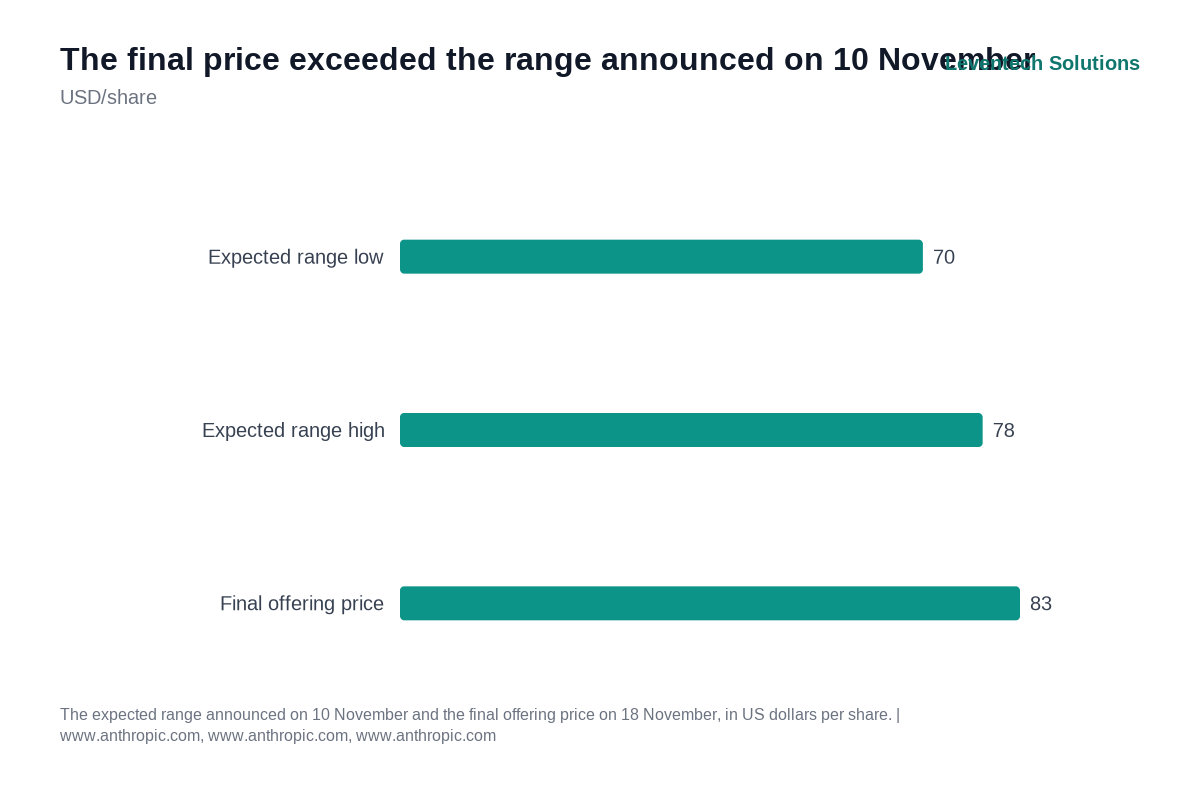 Open full-size chart
Chart data as a table
| The final price exceeded the range announced on 10 November | USD/share |
|---|---|
| Expected range low | 70 |
| Expected range high | 78 |
| Final offering price | 83 |