
Anthropic released Claude Fable 5.2 and Claude Mythos 5.2 on 9 November 2026. Fable 5.2 costs $8 per million input tokens and $40 per million output tokens at standard API rates, a 20% reduction on both Fable 5.1 prices. The lower rate justifies a comparison pilot. For teams in Hungary and Central Europe, production migration should follow three checks: cost per successful Hungarian-language task, processing location and safeguard fallback on the cloud platform planned for production.
How much does Claude Fable 5.2 cost?
The standard API price is $8 per million input tokens and $40 per million output tokens. Anthropic’s model page gives the previous Fable 5.1 rates as $10 and $50, making both Fable 5.2 list prices 20% lower. Cache reads cost $0.20 per million tokens, or 2.5% of the standard input price.
The Microsoft Foundry pricing table lists batch processing at $4 per million input tokens and $20 per million output tokens. That is half its standard rate. The same table prices cache writes at $10 per million tokens, or 1.25 times the standard input rate. These figures apply to Foundry.
The 20% reduction describes token list prices. The company says Fable 5.2 can complete difficult tasks with fewer tokens than Fable 5.1 at Medium effort. Base procurement on cost per successful task, including retries, cache use, failed runs and human review.
Where does Fable 5.2 improve in Anthropic’s own results?
Anthropic’s table shows gains on coding tasks and on the AutomationBench business-workflow benchmark, but Fable 5.2 does not lead on the latter. Fable 5.2 scores 51.4% on AutomationBench, against 31.4% for Fable 5.1. The same table gives Gemini 4 Carbon 53.9%. All results in this section are vendor-reported.
On the FrontierCode 2.0 coding evaluation, Fable 5.2 scores 49.1% and Fable 5.1 scores 32.4%, both at Xhigh effort. That is a difference of 16.7 percentage points. Results for Fable 5.2, Fable 5.1 and Opus 5.5 use safeguards unless stated otherwise. The table reports the highest available effort unless it names a different setting.
The company also says Fable 5.2 at High effort roughly matches Opus 5.5’s best FrontierCode score for about half the cost per task. Compare the models in your own eval with the same prompts, tools and effort setting. If you already use Fable 5.1, revisit the earlier Fable 5.1 migration criteria, because cache use and the length of agent runs still determine the actual bill.
When is Fast mode worth the price?
Fast mode is worth testing where shorter response time has measurable business value. It doubles the standard token price to $16 per million input tokens and $80 per million output tokens. Anthropic claims up to 2.5 times faster generation. At the same token count Fast mode always costs twice as much in tokens, and the 2.5x speed-up is an upper bound.
Measure response time, successful completion rate and cost per successful task separately. Fast mode may make sense when a slower response leaves an employee waiting, causes a technical timeout, or blocks several agents that depend on one another. For background research, batch processing and coding work reviewed later, the lower standard rate may matter more.
The platform list names Claude Platform, Google Cloud, Microsoft Foundry and Claude Code. Amazon Bedrock is absent from that list. Include Bedrock Fast mode in a procurement plan only after the provider confirms availability in writing.
How is data handled across the clouds?
Anthropic classifies Fable 5.2 as a Covered Model. This requires up to 30 days of retention and human safety review by default. According to the AWS announcement, Amazon personnel perform that review inside the AWS boundary for Bedrock users. Eligible customers can use zero data retention for internal workloads until Enterprise Frontier Safeguards is available, through at least 30 June 2027.
Launch-day routing deserves separate attention. AWS names US Geo CRIS and Global CRIS inference profiles. The Microsoft Foundry announcement lists Global Standard and US DataZone deployments. Anthropic’s model page prices US-only inference at 1.1 times the standard input and output rates.
None of these launch listings names an EU processing route. A company in Hungary or Central Europe handling personal data or information contractually restricted to the EU should obtain written terms for processing location, subprocessors, retention and zero-data-retention eligibility before a pilot. The guide to Claude, Copilot and the EU Data Boundary provides additional procurement context. If you are also comparing cloud and company-controlled infrastructure, the on-premise versus cloud AI guide separates data requirements from operating constraints.
If the pilot leads to a platform decision, our enterprise AI platforms page helps you compare the procurement criteria. Enterprise AI Platforms
What must change on Bedrock and Foundry?
On Bedrock, your code handles any retry after a blocked cybersecurity or biology request. The AWS description explicitly says that the retry is not automatic. A declined cybersecurity request can be retried on Opus 4.8, while a biology request can be retried on Opus 5. Anthropic API customers must configure the Fallback API for this behaviour.
The Microsoft description instead says customers receive a response from the corresponding Opus model when a request is blocked. Platform behaviour can therefore differ. Run the eval on the cloud you will use in production, including permitted tasks that safeguards might incorrectly block.
The Bedrock model ID published by AWS is global.anthropic.claude-fable-5-2. Pin the intended model ID in production, log every fallback, and maintain a rollback route to Fable 5.1 or another approved model. An unnoticed model change can alter quality and safeguard behaviour even when the prompt stays the same.
When does a migration pilot make sense?
A migration pilot makes the most sense for teams running complex coding, financial analysis, scientific work or long-running agent tasks on Fable 5.1. Anthropic targets Fable 5.2 at these areas. Lower list prices and reduced token use may cut cost, while Fast mode may shorten completion time.
For a Hungarian-language financial-analysis workflow, score numerical accuracy, source use and interpretation of tables separately. In a data-preparation workflow, also test field mapping and consistency across repeated runs.
| Situation | Recommended decision | Deciding check |
|---|---|---|
| Complex Fable 5.1 workflow | Run a side-by-side pilot | Cost and quality per successful task |
| Stable workflow with no latency pressure | Delay migration | Internal retest and external comparisons |
| Workflow processes personal data | Test after data-protection approval | Processing location, retention and subprocessors |
| New coding or knowledge workflow | Compare with Opus 5.5 | The vendor recommends it as the starting model |
| Immediate responses have business value | Test Fast mode | Response time and total task cost |
Teams with stable Fable 5.1 workflows and no latency pressure may reasonably delay migration. The vendor recommends Opus 5.5 as the starting point for most coding and knowledge tasks. For a new procurement, compare Fable 5.2 with other providers as well; the enterprise proprietary-model guide provides a consistent decision framework.
What should you measure before production?
Before production, compare Fable 5.1, standard Fable 5.2 and, where relevant, Fast mode on the same Hungarian-language task set.
- Select real, anonymised tasks from your documents, codebase or analytical workflow.
- Define acceptance criteria in advance: correctness, completeness, source use, format and permitted human correction.
- Use the same prompt, tools, effort setting and cloud platform for the comparison.
- Calculate cost per successful task from input, output, cache, retries and human review.
- Test Hungarian terminology, long documents and local data fields separately.
- Exercise blocked requests, fallback models, logging, model-ID pinning and rollback.
- Before data-protection approval, document the processing location, 30-day retention and zero-data-retention conditions.
A production migration is justified when Fable 5.2 meets the required quality at a lower cost per successful task or delivers response-time gains with business value, while satisfying the workflow’s data-handling requirements.
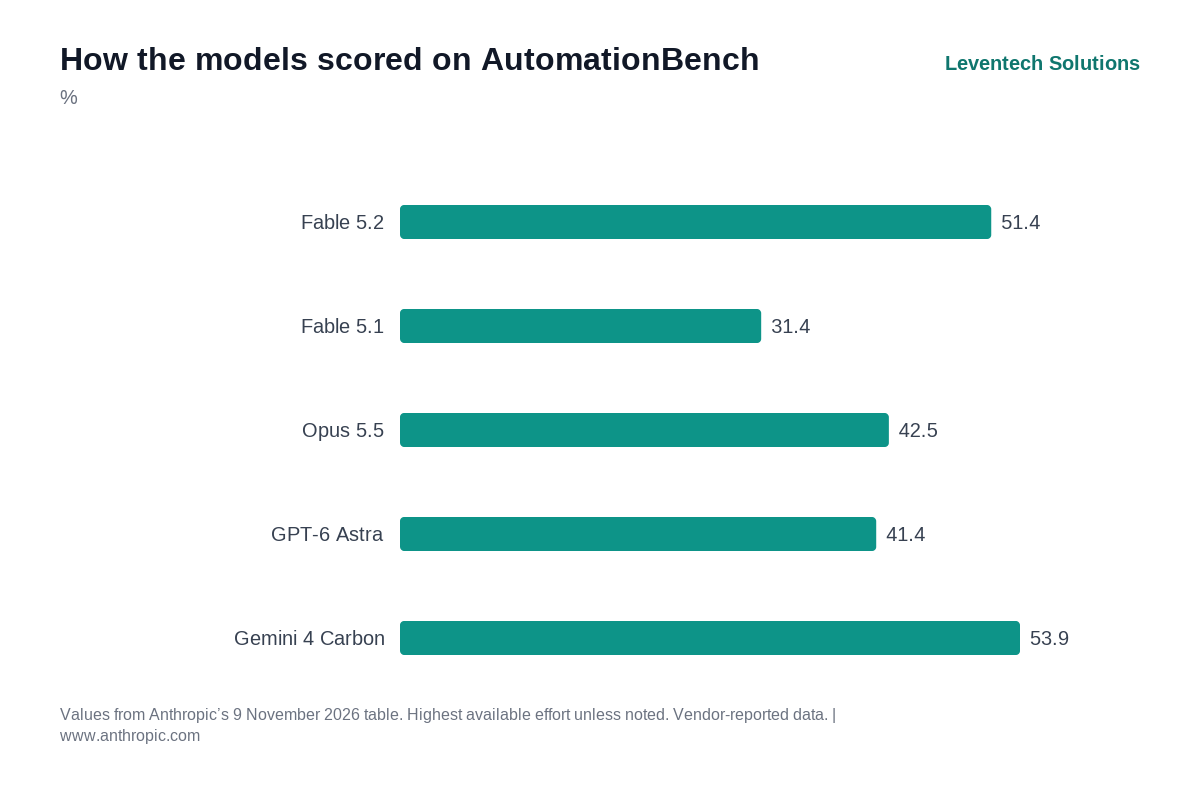 Open full-size chart
Chart data as a table
| How the models scored on AutomationBench | % |
|---|---|
| Fable 5.2 | 51.4 |
| Fable 5.1 | 31.4 |
| Opus 5.5 | 42.5 |
| GPT-6 Astra | 41.4 |
| Gemini 4 Carbon | 53.9 |