
Gemini 4 Hydrogen is most relevant when a high-volume workflow reads substantial material and returns a short, verifiable result. Candidates include extracting fields from Hungarian public-procurement packs, classifying contracts and routing support tickets. Keep the current model in place while you test it.
Google announced Gemini 4 Hydrogen on 12 November 2026. Its list price is $1.50 per million input tokens and $7.50 per million output tokens across the full one-million-token context window. It has four thinking levels and is positioned for fast agentic, coding and multimodal workflows.
The list price favors work with short outputs
At the published rates, an output token costs five times as much as an input token. The model therefore has its clearest price fit in workflows that read a large source set and produce a compact answer. Field extraction, classification and constrained summaries fit that pattern better than long reports or extensive code generation.
Flat pricing across the context window matters for large tender packs, contract bundles and multi-file case histories. Google lists the same input-token rate throughout the one-million-token window, with no higher rate inside that limit for longer context.
Assume a call uses exactly one million input tokens and produces no output tokens. Its list-price charge is $1.50. At the other extreme, the stated maximum output of one million tokens would cost $7.50 before adding input. A useful operating estimate must use the actual token counts from the target workflow.
The available thinking levels are low, medium, high and xhigh, with high as the default. Google links the selected level to latency and cost. Fix Hydrogen's thinking level during the test and require both models to meet the same quality threshold.
Vendor benchmarks show which workload to test first
In Google's testing, Hydrogen completed tasks 2.5 times faster than Gemini 3.8 Flash at the default high setting. On Terminal-Bench 4.1 it scored 57% against 3.8 Flash's 18.2%, slightly more than three times as high.
Unnamed partners reported runs that were 2 to 2.8 times faster and used 12% to 23% fewer tokens than 3.8 Flash on graph, SQL and data-heavy enterprise work. Google does not identify those partners, sample sizes or detailed test conditions. The figures are useful for choosing an initial workload, while the buying decision should rest on the organization's own documents and acceptance criteria.
The developer announcement lists the Gemini API, Google AI Studio, Android Studio and Gemini for business as access routes. Google Antigravity's Orchestrator is a different deployment. Routing between Carbon and Hydrogen reached near-Carbon task success on Terminal-Bench 4.0 while using 24% less quota and finishing 19% faster on average. Those results apply to Antigravity's multi-model routing.
Workflow shape determines whether a pilot is worthwhile
| Buyer situation | Practical action | Decision factor |
|---|---|---|
| You extract fields from long tender or contract packs | Run a bounded comparison | The workflow combines substantial input with short, testable output, while the input rate stays constant across the context window. |
| You classify or route support tickets | Test the same cases on both models | Short outputs may be economical, but misrouting rates determine the business result. |
| You need an execution model for coding or agent pipelines | Test Hydrogen at a fixed thinking level | Google's speed figures address this workload. |
| You generate long reports or large volumes of code | Retain the current model throughout the pilot | Output costs five times as much as input, so the input price alone cannot demonstrate a saving. |
| You process regulated personal data | Complete the contract review before production | Data location, retention and DPA commitments must be documented. |
| The main use is Gemini in Google Sheets | Confirm that the subscription qualifies | Google limits this route to eligible business subscriptions. |
Use the proprietary AI model comparison to apply consistent criteria across providers. For extraction projects, the AI document processing guide covers the workflow around the model.
If you need verifiable data extracted from long documents, see how the complete document-processing workflow is structured. AI document processing
Test cost per accepted result on Hungarian-language work
Build a set of 30 to 50 real, anonymized Hungarian-language cases. For tender processing, include short and long packs, tables, attachments and records with missing fields. A ticket-routing set should contain both straightforward requests and cases that could plausibly go to more than one team. Run the identical set through Hydrogen and the incumbent model.
Define acceptance before testing. An extraction result may need every mandatory field to be correct. A routing result should send the ticket to the approved team. A coding result can require all tests to pass while leaving unrelated files untouched.
Record at least six measures:
- successful task completion rate;
- error rate for critical fields or decisions;
- time spent on human correction;
- input and output token counts;
- model cost per accepted result;
- response time and tool-call failures.
List price covers only one part of the comparison. Lower token use has little value if reviewers spend longer correcting the answer. A more expensive call may still produce a cheaper accepted result when more tasks meet the quality threshold. The AI ROI calculator can help with the payback calculation.
Production requires written data and access terms
Google describes a global rollout across developer, enterprise and consumer products. That statement does not define the contract terms for a particular Hungarian API account, business subscription or data-processing location.
Procurement should obtain written confirmation that the selected account and subscription can use the model from Hungary. The same review should cover processing location, retention period and commitments in the data processing addendum.
Use anonymized or low-sensitivity material until that review is complete. Before production, set logging rules, human approval points, a pinned model identifier and a fallback route. These controls reduce the chance that a model update or service failure changes the workflow without review.
When should you migrate to Hydrogen?
- Record the incumbent model's success rate, correction time and cost.
- Compare both models on the same 30 to 50 Hungarian-language cases.
- Test Hydrogen at a fixed thinking level and apply the same quality threshold to both models.
- Calculate model charges and human correction time per accepted result.
- Plan production only after Hungarian access and data terms are documented.
Hydrogen earns a migration when it reaches the required quality and lowers cost per accepted result or processing time. The five-to-one output price ratio can reverse an early estimate for workflows that generate long answers. If the current process has no baseline, measure it before deciding whether the new model is better.
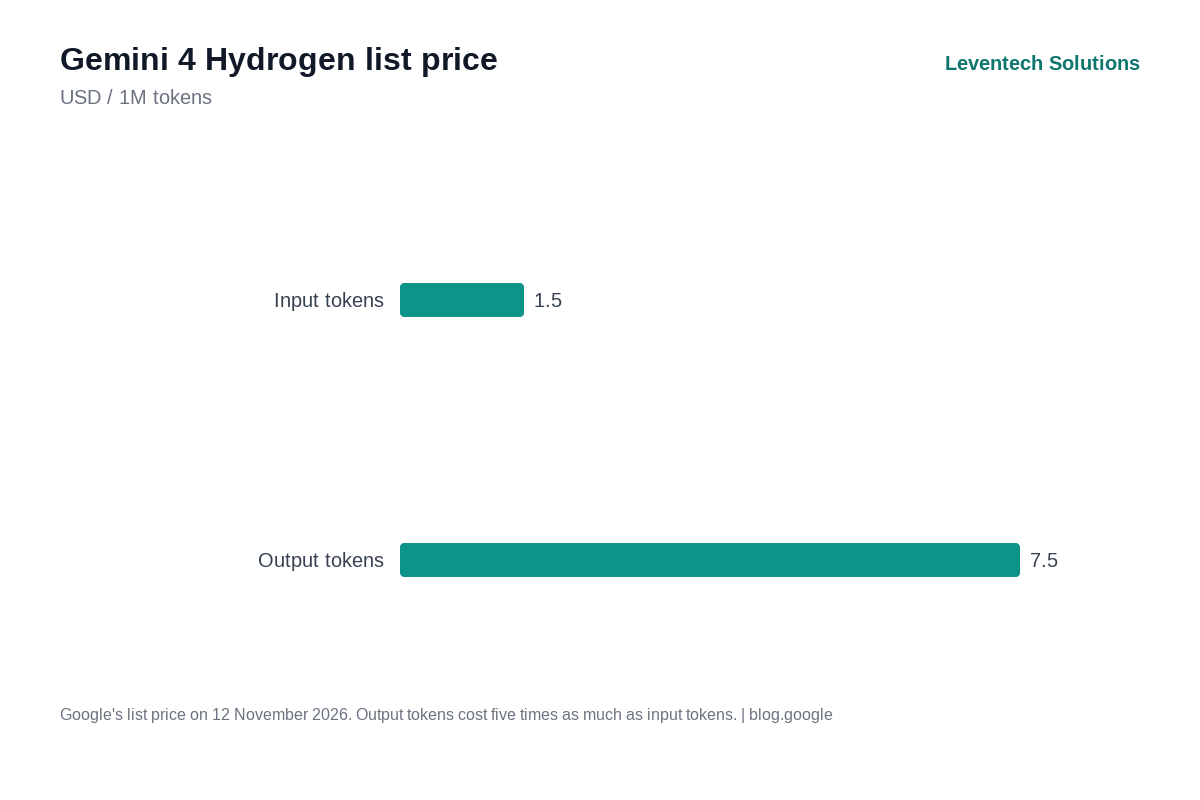 Open full-size chart
Chart data as a table
| Gemini 4 Hydrogen list price | USD / 1M tokens |
|---|---|
| Input tokens | 1.5 |
| Output tokens | 7.5 |