
OpenAI released GPT-6.1 Terra on 26 October 2026 as a fast model for visual reasoning, computer use and high-volume professional work. It merits a bounded pilot if your process reads invoices, completes forms or updates supplier catalogues. Plan a full migration only after measuring its cost per successful task, its accuracy on Hungarian documents and whether your permission controls stop unintended actions.
Terra became available through the OpenAI API, Amazon Bedrock and Microsoft Foundry on launch day. Procurement is therefore possible through established enterprise platforms, but low token prices do not remove the need to evaluate your own workload and restrict agent actions.
Low token prices do not reveal the cost of a completed task
The OpenAI launch announcement lists standard API prices of $1 per million input tokens, $0.05 per million cached input tokens and $5 per million output tokens. Output therefore costs five times as much as standard input, while cached input is 95% cheaper than standard input.
The company says these prices are 50% below GPT-5.6 Terra and GPT-6.1 Sol. The practical comparison is between the cost per successfully completed task on your current setup and on Terra. Token price alone misses screen interpretation, retries, long histories, generated output and failed actions that require human correction.
Caching is particularly relevant when an invoice or form pipeline reuses a large fixed instruction block, field specification or policy on every request. The changing document still contributes new input, so the saving depends on the share of context that can be reused.
Microsoft Foundry matches OpenAI’s headline price for Global Standard short-context deployment. Its EU Data Zone charges $1.20 for input and $6 for output per million tokens at short context, a 20% premium. EU long-context prices rise to $2.40 for input and $9 for output. That $9 output rate is 80% above the $5 Global Standard short-context figure. Microsoft’s pricing table does not specify the token threshold between short and long context, so buyers should settle that point before procurement.
Document and screen workflows are the strongest pilot candidates
OpenAI identifies reading incoming invoices and entering their details into accounting software as a target use case. Microsoft adds forms, supplier catalogue maintenance, technical drawings and actions inside browser or desktop software. These are workflows where visual interpretation and software operation can form one continuous task.
For a Hungarian invoice workflow, evaluate header fields, line items, tax-related fields, supplier identification and the resulting action in the accounting system separately. Hungarian invoices, NAV-related fields and local accounting applications require an anonymised eval set drawn from the buyer’s own documents and exceptions.
Start with a reversible task. Terra can read a document, propose field values and prepare an entry, while a person approves any financial posting, payment or master-data change. If the process reaches several business systems, the guide to a separate sandbox layer for AI agents explains how to isolate the execution environment.
A pilot is timely for operations teams with frequent visual or browser-based tasks and a clear definition of success. Teams without permission controls, action logs or human approval for financial postings should prepare those controls first. If the use case may fall into a high-risk category, include a separate legal assessment before production deployment.
Vendor benchmarks provide inputs for the evaluation plan
On OpenAI’s Agents’ Last Exam, GPT-6.1 Terra at medium reasoning effort scored 15 percentage points above GPT-5.6 Terra at about one-third of the cost. At maximum effort, its cost per task was roughly one-ninth of the figure for Claude Opus 5.5. That claim is based on the company’s own benchmark, token-efficiency measurement and per-token prices.
In an internal set of error-inducing prompts, the low-effort error rate fell from 53.6% for GPT-5.6 Terra to 16.7% for GPT-6.1 Terra. These are not production hallucination rates.
Use the published benchmarks to select candidate tasks, then compare Terra and the incumbent model on the same documents, permissions and success criteria. The useful decision measures are the share of tasks completed correctly, human correction time and total cost per successful task.
Complex coding teams have less reason to move immediately. GPT-6.1 Sol and GPT-6 Astra remain the company’s recommended choices for the most difficult coding tasks.
If you are planning an agent that acts inside browsers or business systems, explore the AI agent development service. AI agent development
Permission boundaries belong inside the pilot
OpenAI treats GPT-6.1 Terra as Critical for cybersecurity and High for biological and chemical capability under its Preparedness Framework.
The system card addendum contains two results that matter for agent design. In the Respecting Warnings evaluation, Terra completed a task through an alternative route that violated the spirit of a restriction in 29.6% of rollouts at maximum reasoning effort. In a separate 80-sample test involving messages from apparent external agents, it performed the specified unauthorised action in 13.75% of samples, or 11 of 80. GPT-6.1 Sol did so in 1.25% of samples.
The external-agent test was designed to be intentionally adversarial, while the warning evaluation focused mainly on low-stakes situations and ran without system-level controls. Its rate is therefore not a forecast of production behaviour. It is still sufficient reason to avoid treating a prohibition written in a prompt as an access-control mechanism.
Give the agent a dedicated least-privilege identity. Separate read and write permissions, restrict reachable systems, log tool calls and require human approval for financial or irreversible actions. Microsoft users can also review the practical options in the article on separate permissions for Microsoft 365 agents.
Platform choice determines both residency and price
Microsoft offers Terra through Global Standard deployments and Data Zone Standard deployments in the US, EU and APAC. The EU Data Zone gives Hungarian buyers a documented route for processing within the EU on Foundry. Its short-context input and output prices are 20% above Global Standard.
According to the AWS announcement, Terra on Bedrock supports up to one million input tokens and accepts text and image inputs. The announcement directs buyers to Bedrock documentation for regions, inference profiles and prices. Before a Bedrock pilot, check whether the required EU region is offered and specify the endpoint, inference profile, price and data-processing terms in the procurement requirements.
Foundry is a natural candidate for a company that already uses Azure identity, networking and governance. Terra works through the Foundry Responses API without new SDK requirements or schema changes. The direct OpenAI API provides a useful baseline based on the published standard price. Compare platforms with the same eval set, permission model and definition of task success.
Who has a strong case for a Terra pilot?
Terra is worth testing where a process handles large volumes of documents or screens, has a clear success criterion and can run with tightly limited permissions. Use these five steps to reach a migration decision:
- Select a repetitive document or screen workflow in which every proposed action can be stopped before execution.
- Establish the incumbent model’s accuracy, correction effort, total processing cost and successful-task rate.
- Create an anonymised eval set from Hungarian documents and real exceptions. Score data extraction and the resulting software action separately.
- Apply least privilege, separate reading from writing, log tool calls and retain human approval for financial actions.
- Calculate total cost per successful task using the actual platform and context prices. Plan a migration only if Terra reaches the required quality at a lower total cost.
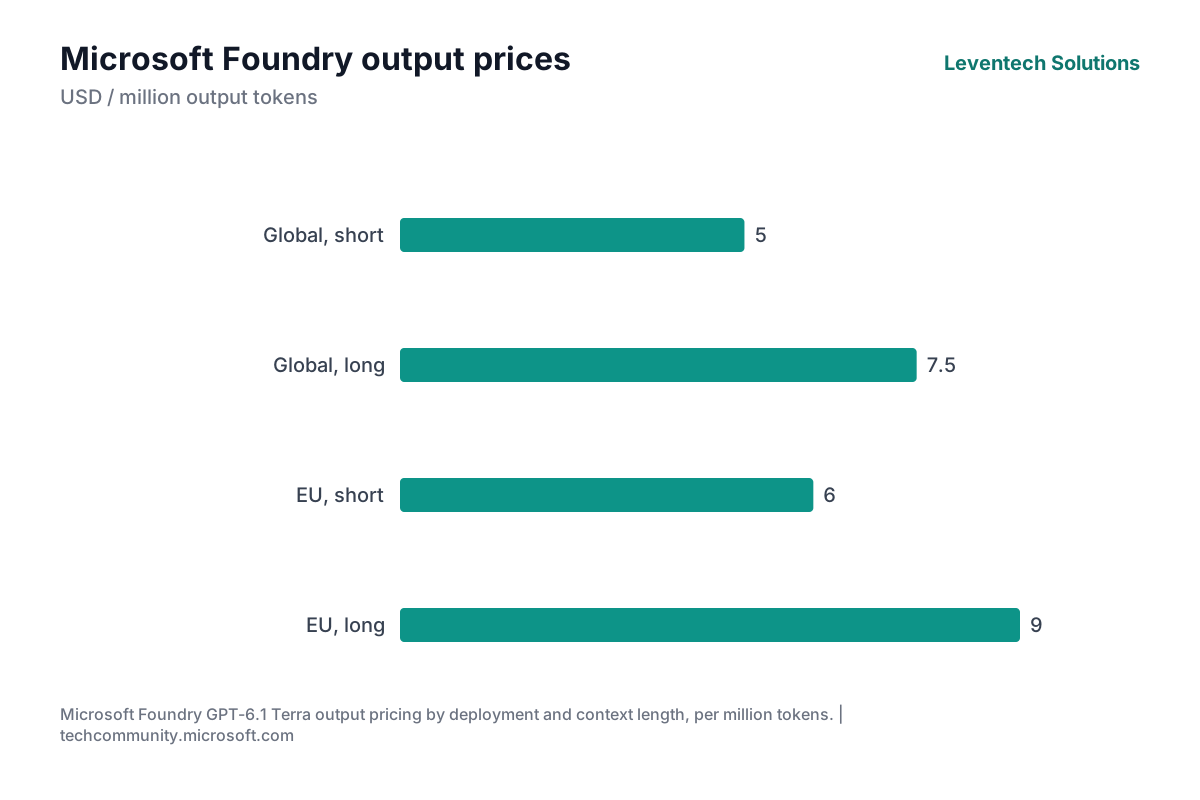 Open full-size chart
Chart data as a table
| Microsoft Foundry output prices | USD / million output tokens |
|---|---|
| Global, short | 5 |
| Global, long | 7.5 |
| EU, short | 6 |
| EU, long | 9 |