
For a small company with at least two users, ChatGPT Business Standard is the practical starting point. It lists at $20 per user per month on annual billing or $25 on monthly billing. With the general two-seat minimum, that means an initial monthly cost of $40 or $50. Reserve Premium for people who repeatedly reach Standard limits in ChatGPT Work or Codex. Ask for an Enterprise proposal when EU data residency, SCIM, role-based access, custom retention or invoice payment is mandatory.
How much do Standard and Premium cost?
OpenAI's Business pricing lists Standard at $20 per user per month on annual billing and $25 on monthly billing. Premium is $100 and $125 respectively. Prices can vary by country and currency, so a company using a Hungarian billing address should budget from the currency, tax and final total shown at checkout.
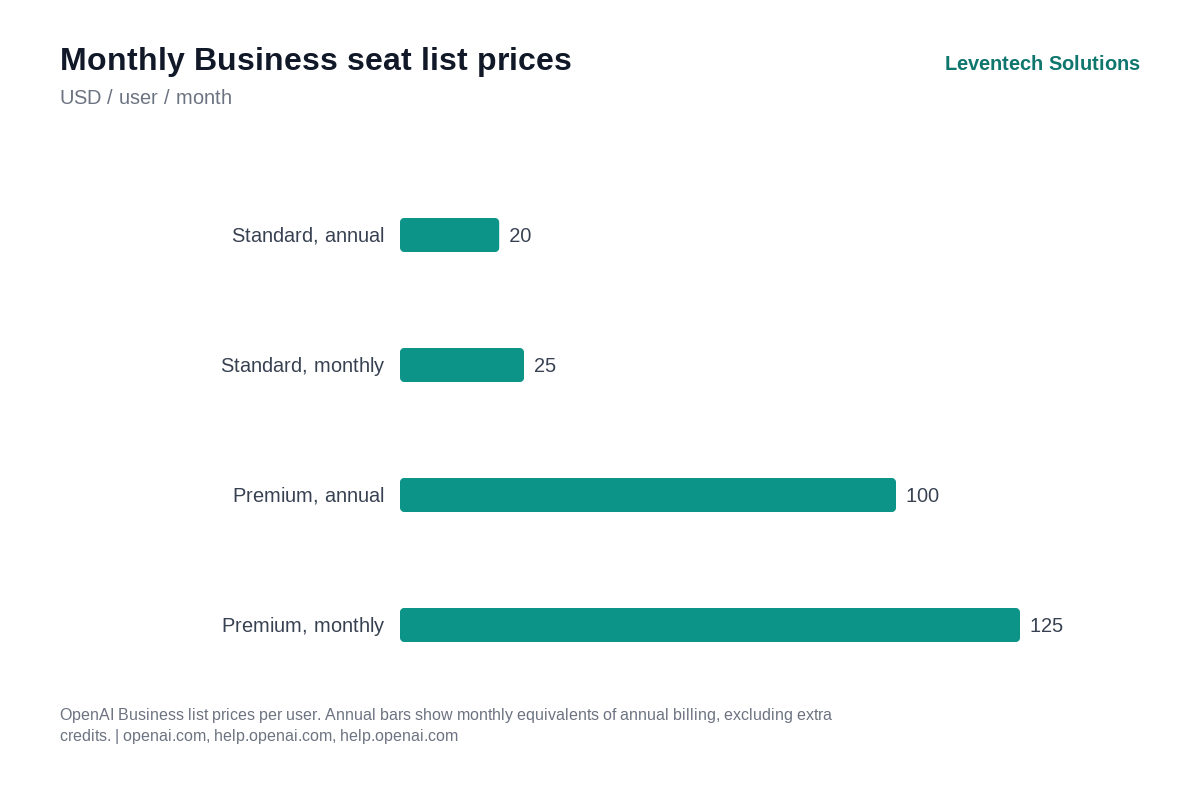 Open full-size chart
Chart data as a table
| Monthly Business seat list prices | USD / user / month |
|---|---|
| Standard, annual | 20 |
| Standard, monthly | 25 |
| Premium, annual | 100 |
| Premium, monthly | 125 |
The Business overview allows Standard and Premium seats in the same workspace. One of each also satisfies the general requirement for two paid seats.
Business is a self-service plan purchased by card. If your procurement policy requires an invoice, purchase order, bank transfer or negotiated payment terms, you need a contracted offering. Settle this with finance before the pilot, especially if card-based SaaS purchases sit outside your usual approval process.
When is Standard enough?
Standard covers most general office work: drafting, document summaries, data analysis and occasional Codex use. It includes ChatGPT, ChatGPT Work and Codex, along with a shared workspace, central billing, administrative controls, SAML SSO, MFA, usage analytics and spending controls.
A team working in Hungarian and English can start with tasks such as:
- drafting Hungarian and English customer emails;
- summarising contracts and requests for proposal with human review;
- explaining spreadsheets and performing occasional data analysis;
- organising meeting notes;
- handling intermittent Codex tasks for a developer or technical employee.
In its Business overview, OpenAI states that it does not train its models on Business workspace data. Your company still needs rules for what employees may enter. Classify the data first, then review the relevant terms in customer, employee and supplier contracts.
Plus is an individual plan. It may suit a sole operator who has no need for a shared workspace or central administration; check the current price and limits when buying. Business becomes easier to manage once several colleagues collaborate on company work. The Business FAQ also clarifies that a personal Pro subscription does not turn into a Business Premium seat. A workspace owner must assign Premium capacity separately.
When does a Premium seat make sense?
Premium makes sense for a named user whose work is repeatedly interrupted by a Standard usage limit. OpenAI provides higher usage for ChatGPT Work and Codex, and the five-hour limit does not apply to Premium.
At annual prices, one $100 Premium seat costs the same as five $20 Standard seats. That ratio does not reveal a usage break-even point. The vendor assigns no fixed credit or dollar value to Premium's additional included usage.
- A developer running several long Codex tasks each day may justify Premium after repeated Standard limit hits are documented.
- For an analyst or manager using long ChatGPT Work tasks, track how often work stops and how much time the interruption costs.
- Standard remains the better fit when limits are rare and tasks are short.
- The whole team does not need the same seat type. Owners can mix and reassign Standard and Premium capacity within one workspace.
OpenAI says ChatGPT and Codex will move under a shared plan limit in December 2026. Review Premium assignments based on November usage once that change is in place.
How does the billing cycle change the real cost?
Monthly billing costs 25 percent more than the monthly equivalent of annual billing for both seat types. During a pilot, that premium buys a smaller initial commitment. The examples below assume that list prices remain unchanged for twelve months; taxes, extra workspace credits and API usage are excluded.
- Two Standard seats on annual billing have a monthly equivalent of $40.
- In an eight-person example, Standard seats have a monthly equivalent of $160 on annual billing.
- One Standard seat costs $240 for a year on annual billing. Keeping it on monthly billing for twelve months costs $300.
- One Premium seat costs $1,200 a year, equal to the annual price of five Standard seats.
OpenAI's Business general FAQ states that added seats trigger an immediate prorated charge. Reductions take effect at the start of the next billing cycle, while unused capacity does not by itself qualify for a refund. Begin with monthly billing, observe one full cycle, then switch to annual billing at the confirmed active seat count.
If you want to choose ChatGPT licences through a business pilot, an AI assessment can define the workflows and decision criteria. AI consulting for SMEs
When should you request an Enterprise proposal?
Request an Enterprise proposal when procurement, identity or data requirements exceed the Business feature set. A new Business subscription supports up to 200 paid Standard and Premium seats; OpenAI directs larger deployments towards Enterprise.
The Business and Enterprise comparison and Business overview point to Enterprise for requirements including:
- data residency in the EU or another listed region;
- SCIM user provisioning;
- granular role-based access controls;
- IP allowlisting and the Compliance API;
- custom retention policies and Zero Data Retention;
- payment by invoice, purchase order, bank transfer or custom contract terms;
- more than 200 paid seats.
Business workspaces do not provide self-service data export. Members can invite others using the default seat type while capacity remains, and that permission cannot currently be disabled. Administrators and owners also cannot see every private member chat by default. If these conditions conflict with your access policy or exit plan, ask how they are handled when you request an Enterprise proposal.
Enterprise pricing is custom. Some agreements use token-based billing, but the Enterprise rate card applies only to eligible contracts. The published rates do not replace a proposal made to your company.
Do API and Codex require separate subscriptions?
Codex is included with Standard and Premium Business seats. API usage is a separate product with separate usage charges and billing. A Business subscription therefore does not cover the API calls made by an application built solely on the API platform.
OpenAI stopped selling new Codex-only pay-as-you-go seats on Business plans on 24 June 2026. The Codex pricing announcement leaves existing seats unaffected. Under the Business FAQ, new self-service workspaces receive Codex through Standard or Premium seats. A new buyer is choosing among Standard, Premium and Enterprise.
How should you choose for your company profile?
User count, the concentration of heavy usage and mandatory company controls determine the plan.
| Company situation | Suggested route | Initial billing | Check before buying |
|---|---|---|---|
| One user with no shared workspace | Compare individual plans | Under the selected plan's terms | Data terms and usage limits |
| 2–50 general office users | Business Standard | Monthly | Active users and cost per completed task |
| A few heavy developers or analysts | Mix Standard and Premium | Monthly | Frequency of limit hits and time lost waiting |
| EU data residency, SCIM or invoice payment is mandatory | Enterprise proposal | Under the negotiated proposal | Contract, permissions and exit terms |
| A team building API-based applications | Separate API platform | Usage-based | API budget and spending limits |
Source: OpenAI's Business pricing, Business overview and Business FAQ.
Work through this list before buying:
- Inventory current individual subscriptions and identify the employees who will genuinely use a shared workspace.
- Select several real workflows and define which data may enter the service.
- Start the smallest workable pilot group on monthly Standard seats, with at least two paid seats.
- For one full billing cycle, log active days, completed tasks, limit-hit frequency and time lost to waiting.
- Measure the share of results accepted without substantial revision while retaining any required human review.
- Give Premium only to users who repeatedly reach limits. Move to annual billing after confirming the active user count.
If plan selection is part of a wider programme, AI consulting for SMEs can help structure the workflow decision. How much does AI adoption cost in 2026? covers the wider implementation budget.
Include Hungarian customer correspondence, Hungarian document summaries, spreadsheet analysis and Codex work when they reflect the intended use.