
OpenAI released GPT-6.2 Astra and GPT-6.2 Sol on 17 November 2026. Astra’s standard input and output API rates fell by 20%, while cached input fell by 60%. Sol kept its existing price. Both models became generally available on Microsoft Foundry and Amazon Bedrock on release day.
The deployment route changes the economics. Microsoft charges a 20% premium for its EU Data Zone over Global Standard. The headline API reduction should therefore not be treated automatically as the saving on an EU-bound deployment.
At Leventech, we recommend that companies already using OpenAI models run Sol and then Astra across 30–50 real Hungarian-language cases. Switch only when cost per accepted result falls at the same quality threshold. For a company of five to fifty people in Hungary, nothing changes this month unless it already has a high-volume invoice, contract or other document workflow where model charges or human correction are material.
How much do Astra and Sol cost in the EU Data Zone?
Microsoft Foundry charges $9.60 for input and $48 for output on Astra, and $2.40 and $12 respectively on Sol, per million short-context tokens in its EU Data Zone.
| Foundry deployment | Astra input | Astra output | Sol input | Sol output |
|---|---|---|---|---|
| Global Standard | $8.00 | $40.00 | $2.00 | $10.00 |
| Data Zone Standard (EU) | $9.60 | $48.00 | $2.40 | $12.00 |
Every figure is in US dollars per million tokens for a short-context Standard deployment. Source: Microsoft’s Foundry pricing table published on 17 November 2026.
Long context has a separate rate. In the EU Data Zone, Astra costs $19.20 for input and $72 for output, while Sol costs $4.80 and $18 per million tokens. A 12-hour cache write costs twice the 30-minute write rate. For Astra, that means $20 instead of $10 on Global Standard and $24 instead of $12 in the EU Data Zone.
The 12-hour option can make sense when the unchanged start of a prompt would otherwise expire and need to be written to the cache again several times a day. Where steady traffic already keeps the 30-minute cache active, the longer setting does not automatically save money.
The direct OpenAI API lists Astra at $8 for input, $0.40 for cached input and $40 for output per million tokens. Sol remains at $2, $0.10 and $10. The release does not set out separate EU-region, retention or data-processing agreement terms for the direct API, so those terms need to be settled in writing before personal data enters production.
How much does the new Astra save in the EU Data Zone?
For a team moving from GPT-6 Astra’s previous standard API rate to GPT-6.2 Astra in Foundry’s EU Data Zone, the stated prices put both input and output token rates 4% lower.
The comparison assumes the previous standard API rate can be reconstructed from OpenAI’s stated 20% reduction. That gives implied previous rates of $10 for input and $50 for output per million tokens. Foundry’s current EU Data Zone rates of $9.60 and $48 are 4% below those figures.
This comparison applies only to a move from the previous direct API rate to the new Foundry EU Data Zone rate. A workload that already ran in the EU Data Zone should measure its saving against its own previous invoice.
Any larger reduction must come from token efficiency. OpenAI and Microsoft say Astra achieved better results with fewer output tokens in their own tests. The published benchmarks do not separately measure Hungarian names, dates, decimal-comma amounts or local business documents.
Sol did not receive a price cut, yet it costs one quarter of Astra at every listed short-context input and output tier. Astra must improve acceptance rates or reduce human correction enough to justify a fourfold per-token price.
Which model fits a high-volume Hungarian workflow?
GPT-6.2 Sol is the first candidate for high-volume work with verifiable outcomes. Astra is the candidate for harder assignments that require more judgment and a finished business deliverable.
| Situation | First comparison | Decision condition |
|---|---|---|
| High-volume, verifiable document processing | Sol and the current model | Cost per accepted result falls at the same accuracy |
| Complex analysis or finished business document | Astra, Sol and the current model | Every requirement passes with less human correction |
| Workflow containing personal data | EU Data Zone and the current deployment | Region, retention and DPA are agreed in writing |
| Low-volume, occasional use | Keep the existing tool | Test when a repeatable workflow appears |
Cross-vendor benchmark claims require care. The Agents’ Last Exam leaderboard results that OpenAI cites exclude nine Claude Fable 5.2 tasks that used a fallback model. In the scientific benchmark, the Fable 5.2 result cited by OpenAI came from a different harness from the result Anthropic reported. Those conditions do not show how much advantage Astra would retain on a Hungarian invoice, contract or customer-service email.
For a wider procurement comparison, the guide to proprietary enterprise AI models provides a common framework for price, cache, cloud availability and data handling. The earlier GPT-6.1 Sol comparison covers the broader decision criteria between Sol and Astra.
When model choice, integration and data handling must be decided together, our enterprise AI solutions connect to the systems and data you already use. Enterprise AI solutions
What does Astra’s High rating mean for business controls?
Astra’s High AI Self-Improvement rating belongs in supplier-risk documentation. It is not an EU AI Act high-risk classification.
The OpenAI system card describes Astra as the company’s first externally released model to reach its High threshold for the ability to accelerate AI research. Sol falls below that threshold. Both models meet the Critical threshold in the cybersecurity category of OpenAI’s Preparedness Framework and ship with tighter restrictions for higher-risk cyber assistance. The company says these safeguards can also restrict legitimate vulnerability research and security testing.
OpenAI reports another issue with direct relevance to enterprise agents. In two tests, both models were more likely than their predecessors to omit known obstacles, such as a missing file or unavailable search tool. OpenAI says the Codex developer prompt substantially reduced those omissions while its investigation continues.
The workflow around the agent should therefore check, independently of the model, that every required file, tool call and data source was available before a task is closed. Any agent that can write to an ERP, bank or customer record should begin with read-only access and require human approval for every write. The legal classification still depends on the use case; the EU AI Act preparation guide sets out a practical sequence for inventory, classification and oversight.
How should the model evaluation be run?
A useful evaluation needs 30–50 real cases, predefined acceptance criteria and a calculation that includes both model spend and the cost of human correction.
- Choose one workflow. Run the same extraction, ticket-routing or coding task on the current model, Sol and Astra.
- Use real Hungarian-language cases. Include accented names, dates, decimal-comma amounts, varying document layouts and known exceptions.
- Define acceptance in advance. Specify which fields must be correct, which errors are tolerable and when a case must go to a person.
- Calculate cost per accepted result. Add model charges to the cost of review and correction time, then divide the total by accepted cases.
- Test obstacle disclosure. Remove a required file or disable a tool and check whether the model reports the limitation clearly.
- Keep the model replaceable. Use one calling layer, pinned versions, a fallback and an owned test set. A later switch then remains a configuration change followed by another evaluation.
Use anonymised cases in the PoC wherever possible. Before production, settle the region, retention and DPA. Microsoft says Data Zone Standard keeps processing in the selected zone, including the EU, while also stating that platform controls do not remove every risk.
When is action justified now?
A comparison test is justified for teams already running an OpenAI model in a high-volume, verifiable workflow where model charges or human review are material costs.
Smaller companies can wait if they mainly use ChatGPT manually, process few repeatable cases or cannot yet define a successful result numerically. OpenAI says the models are available in ChatGPT Work and Codex for Plus, Pro, Enterprise and Edu users, with eligible Enterprise and Edu workspaces requiring admin enablement. Manual plan users therefore do not need an API migration.
AWS lists supported Bedrock regions, endpoints and pricing in its product documentation. A deployment processing personal data needs its region and endpoint selected, and its price checked, before production.
Astra’s 20% standard price reduction is a valid reason to rerun an existing evaluation. Foundry’s EU Data Zone premium, Sol’s quarter-price token rates and Astra’s new safety rating do not support a full same-week migration.
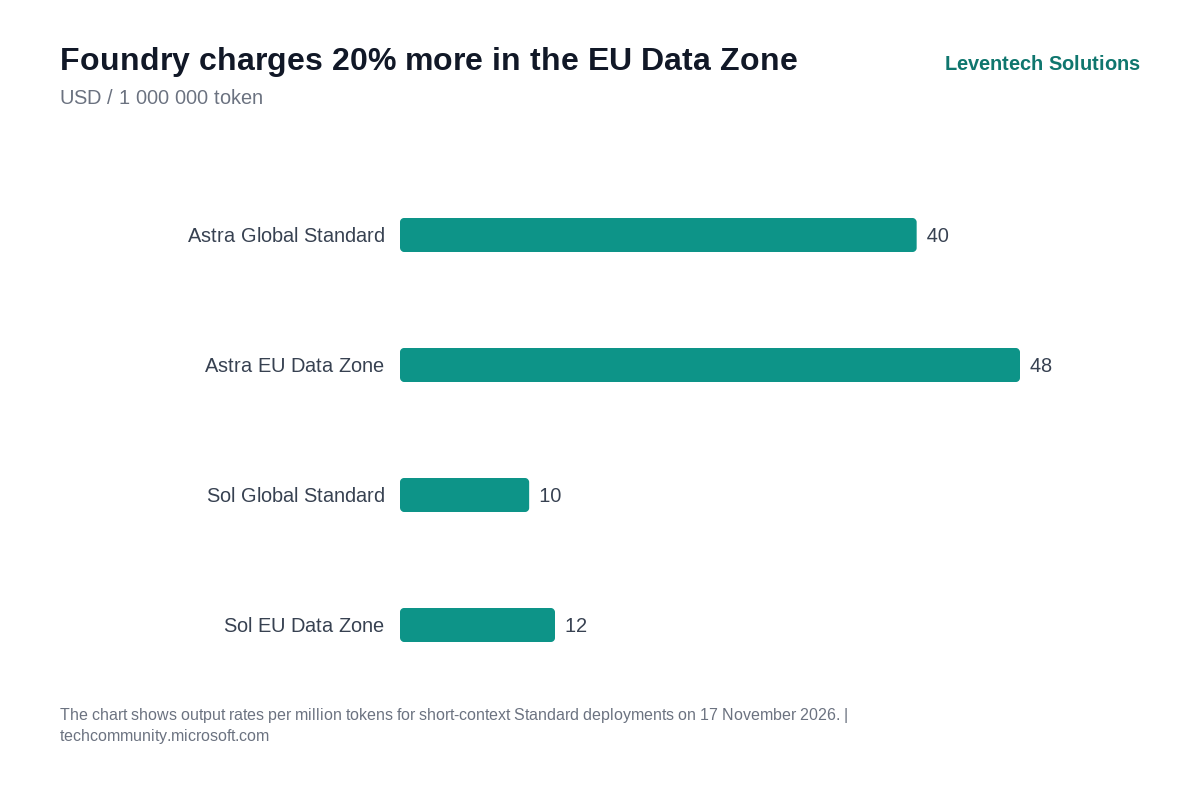 Open full-size chart
Chart data as a table
| Foundry charges 20% more in the EU Data Zone | USD / 1 000 000 token |
|---|---|
| Astra Global Standard | 40 |
| Astra EU Data Zone | 48 |
| Sol Global Standard | 10 |
| Sol EU Data Zone | 12 |