
OpenAI took the Decisions API out of beta on 22 October 2026. A pilot makes sense when your company repeatedly routes support tickets, classifies documents or checks an agent’s proposed next step before execution. Keep production traffic on the current path until the new endpoint meets your accuracy and latency targets on Hungarian-language cases, sends uncertain results to reviewers and passes a rollback test.
Which decisions belong on this endpoint?
The Decisions API responds in predefined formats. Its developer guide lists three: a probability that a condition is true, a choice from supplied categories, or a score against an ordered rubric. Choice responses also include probabilities for each option and a confidence field.
This narrow scope fits workflow steps whose possible outcomes are already known. Examples include routing a service ticket among billing, technical support and account access; classifying a document type; scoring issue severity; and deciding whether an agent should continue, retry or hand the case to a person.
The native GPT-Live integration can call Decisions during a conversation. In a Hungarian-language contact centre, that could select the next question or escalation destination. Speech recognition and spoken-response quality still need separate evaluation.
The endpoint accepts text, images and native JSON. It does not accept files, audio or item references directly. An invoice workflow therefore needs distinct stages:
- Another component converts the PDF into text, images or structured data.
- Responses API Structured Outputs extracts fields into the required JSON schema.
- Decisions classifies the document, selects the processing route or flags the case for review.
The AI document processing guide covers the wider architecture. Decisions can take over the step where the application must select from predefined answers.
Which workloads justify a pilot?
The strongest candidate is frequent, has a small and stable answer set, and produces errors that can be identified quickly. It also needs a safe route for cases outside the listed categories. Tasks requiring free-form text, an explanation or multiple extracted fields belong on a different endpoint.
| Situation | Recommended decision |
|---|---|
| You route many tickets or documents into a small set of stable categories | Run a comparison pilot beside the current method. |
| You need extracted fields, a summary or written reasoning | Use Responses API Structured Outputs. |
| You want to send PDFs or audio directly | Add a conversion or extraction stage first. |
| Dependence on gpt-6-luna alone is unacceptable | Keep the current provider and use a provider-neutral interface. |
| You lack labelled Hungarian-language cases | Prepare real, anonymised examples and acceptance rules before testing. |
One request can contain up to 400 questions, double the public-beta limit of 200. This is useful when the same evidence needs several clearly separated evaluations. If you group questions into one request, log which answer triggered each business action.
How much weight should you give the speed figures?
OpenAI says the endpoint can respond up to ten times faster than GPT-6 Luna through the Responses API. Without disclosed test conditions or independent results, that figure is something to verify in your own pilot.
In a quote on OpenAI's launch page, Box reports roughly five times faster route selection with the same accuracy as the Responses API. Its evaluation covered 30 certificate-of-insurance cases. In its operating workflow, Box sends lower-confidence cases to reviewers.
The tenfold and fivefold figures come from different measurements and cannot be ranked against each other. Thirty cases can show whether an approach is promising; they cannot describe performance on your traffic. Hungarian-language accuracy is unknown, so compare Decisions with the current process using your own tickets, policies and documents. A multilingual service desk should evaluate each production language separately.
Average accuracy can hide the mistakes that cost the most. Keep separate pilot measures for:
- the share of correctly classified cases;
- the number and business impact of incorrect automatic routes;
- the share sent to human review;
- latency at percentiles that matter to the workflow;
- total cost per correctly handled case.
How much does the Decisions API cost?
The list price is $0.10 per million input tokens. Cached input costs $0.01 per million tokens, a 90% discount from the standard input rate. Only input tokens are billed; there is no output-token charge.
That changes the main cost driver. The amount of submitted context matters more than the length of the answer. Cache reads may produce meaningful savings when requests repeatedly use the same category definitions, internal policies or scoring rules. The 30-minute and 12-hour cached writes are priced separately, so include them in the cost model.
A monthly estimate requires actual token volume, cache-hit rate and request structure. Cost per correctly handled case is more useful than token price by itself. It should include conversion or extraction stages, human review and the work required to correct a bad route.
If you plan to place a decision with predefined answers inside an AI agent, define quality, cost and fallback requirements before the pilot begins. AI agent development
What does EU regional processing cover?
OpenAI says inference can run in the EU or the US. Zero Data Retention is available to eligible customers.
Regional processing alone does not settle storage, logging, subprocessors or retention periods. Procurement and data-protection reviews should obtain the contractual terms for each item and confirm eligibility for Zero Data Retention. The documentation also lists Private Link support. If private connectivity is required, include its technical and regional conditions in the procurement requirements.
How do you keep the model replaceable?
The Decisions API currently supports only gpt-6-luna. The pilot architecture will therefore determine how expensive a later model or provider change becomes.
Keep category names, descriptions and acceptance rules in your own system. Do the same with the labelled Hungarian evaluation set and the thresholds for human review. A separate adapter should map the three API answer types into an internal decision schema. Test the fallback before production launch.
If the wider agent stack may also move to one vendor, the Agents API decision guide examines that broader dependency. Decisions returns an answer; the application executes the action. Preserve separate permission checks and human approval before significant or hard-to-reverse operations. The guide to an agent sandbox layer covers additional boundaries between an agent and affected systems.
How should you prepare the pilot and migration decision?
- Choose one decision with predefined answers. Start with a frequent classification, routing or pre-approval check whose possible answers can be listed in advance.
- Build a Hungarian-language evaluation set. Use real, anonymised cases, including rare, ambiguous and out-of-category inputs.
- Run both approaches in parallel. Compare the current system and Decisions on accuracy, latency, review rate and cost per correctly handled case.
- Set the review threshold. Decide which probability or confidence level sends a case to a person, then test inputs that fall outside the defined categories.
- Write down the migration criteria. Route production traffic only after the endpoint meets the agreed quality, data-handling and cost requirements and the rollback path has passed testing.
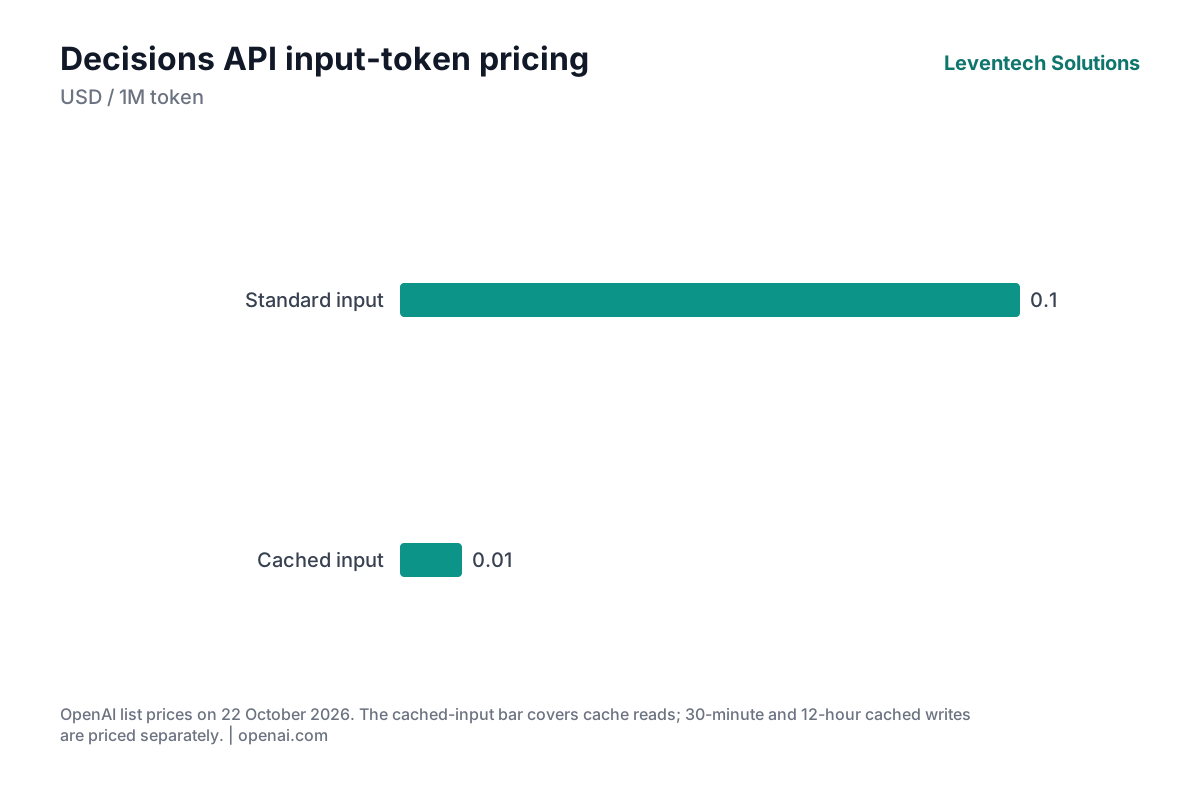 Open full-size chart
Chart data as a table
| Decisions API input-token pricing | USD / 1M token |
|---|---|
| Standard input | 0.1 |
| Cached input | 0.01 |