
On 14 October 2026, OpenAI notified developers that the listed API versions of GPT-4o, GPT-4o mini, GPT-4.1 and GPT-4.1 mini will shut down on 14 January 2027. If one of these models runs a chatbot, document pipeline or internal automation, begin the migration now. OpenAI recommends gpt-6-luna, but production traffic should move only after an evaluation using your actual languages and workflows.
Companies already using GPT-5.6 or GPT-6 models can defer this specific migration. The same applies when neither the company nor its software suppliers call the OpenAI API. The deprecations page lists several other shutdown dates, so check the full model inventory rather than these four product names alone.
Exactly which models shut down on 14 January 2027?
The notice identifies specific versions from four model families. The recommended replacement for each one is gpt-6-luna.
| Retiring model | Model ID | Recommended replacement |
|---|---|---|
| GPT-4o | gpt-4o-2024-08-06 | gpt-6-luna |
| GPT-4o | gpt-4o-2024-11-20 | gpt-6-luna |
| GPT-4o mini | gpt-4o-mini-2024-07-18 | gpt-6-luna |
| GPT-4.1 | gpt-4.1-2025-04-14 | gpt-6-luna |
| GPT-4.1 mini | gpt-4.1-mini-2025-04-14 | gpt-6-luna |
Fine-tuned versions follow the same shutdown schedule as their base models. Your inventory therefore needs to include fine-tuned model IDs as well as direct calls to the base models.
The documentation names dated model versions, so a product name alone is insufficient for deciding whether an integration is affected. The optional shutdown_date field returned by GET /v1/models can be used to monitor retirement dates programmatically. Add this check to routine operational monitoring for production integrations.
The same page also contains earlier deadlines. For example, gpt-4.1-nano and its 14 April 2025 version shut down on 23 October 2026, with gpt-5.6-luna listed as the substitute.
Why does this migration need a faster plan?
There are three months between the announcement and shutdown. On the same page, OpenAI states a general minimum notice period of six months for generally available models, unless safety or compliance concerns require a faster timeline. The page gives no reason for the shorter period in this case.
Do not plan around the usual six-month notice period. Treat the model change like a mandatory external API upgrade, with an owner, an evaluation set, a rollback plan and an internal deadline.
Dedicated capacity may allow continued access after shutdown in some cases through the sales channel. Base a business-continuity plan on this route only after the option and its terms are confirmed contractually.
How should you compare GPT-4.x with Luna?
The OpenAI migration guide recommends establishing a baseline with representative requests and important edge cases. Record the current model's quality, latency and cost, then run the same cases against Luna.
For a Hungarian customer-service workflow, include accented names, inflected product names, Hungarian date formats, and both formal and informal forms of address. A document workflow should cover Hungarian tax identifiers, decimal commas, tables and scanned pages. A multilingual rollout should keep separate evaluation sets for every language used in production.
The comparison should cover at least:
- correct and commercially acceptable answers;
- output formatting and structured fields;
- tool calls and error handling;
- latency and failed requests;
- total API cost per successful task.
OpenAI recommends starting Luna with reasoning effort set to none and says it expects most GPT-4.x use cases to migrate with that setting. Use your own evaluation to determine whether a higher setting is required.
Timing also matters for systems that process images or scanned documents. According to the OpenAI API changelog, an image-encoding bug that degraded image understanding in GPT-6 Luna and Sol was fixed on 25 September 2026. Rerun image evaluations performed before that fix. Further testing criteria are available in the guide to retesting GPT-6 Sol and Luna.
How much does standard GPT-6 Luna usage cost?
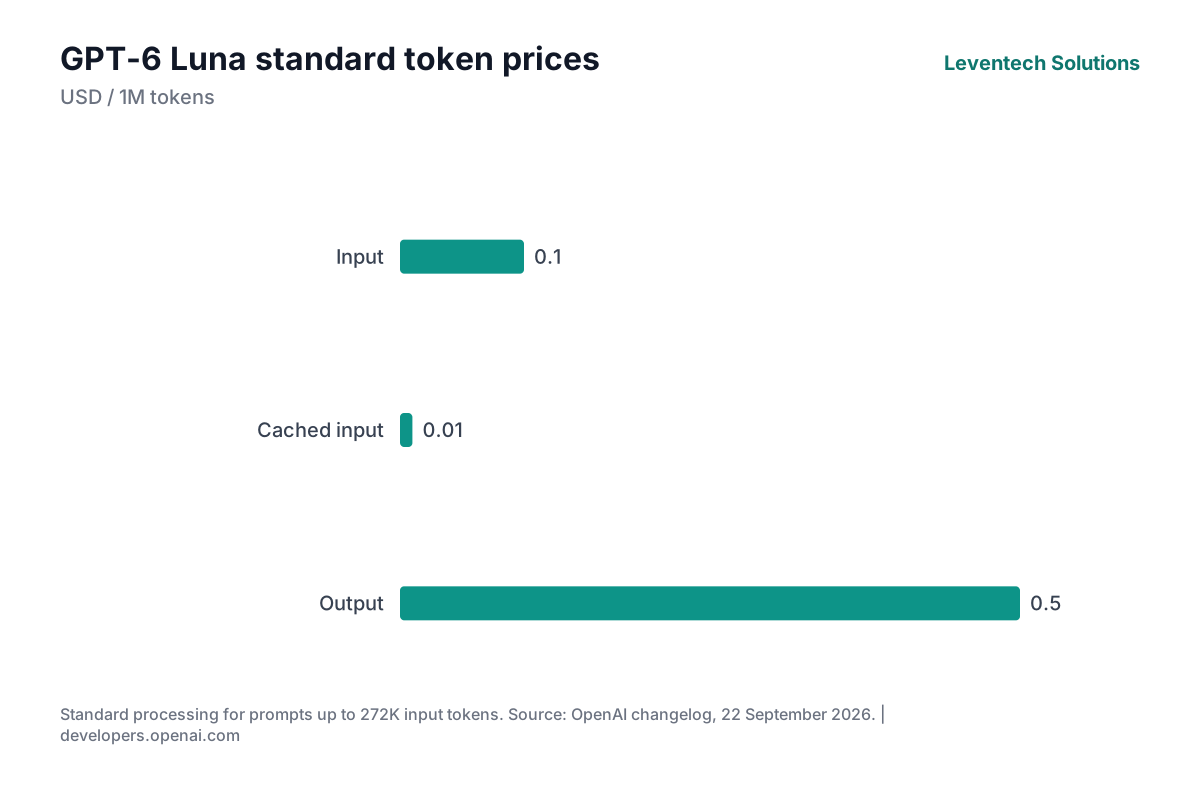
GPT-6 Luna was released on 22 September 2026. According to the OpenAI API changelog, its prices for standard processing with prompts up to 272K input tokens are:
| Token type | Price per 1M tokens |
|---|---|
| Input | $0.10 |
| Cached input | $0.01 |
| Output | $0.50 |
Unit: US dollars per 1 million tokens. Source: OpenAI API changelog, 22 September 2026.
Output costs five times as much as input. Cached input is 90% cheaper than uncached input. Output-heavy workflows will therefore be sensitive to response length, while applications with repeated long prefixes may benefit substantially from effective cache use.
The OpenAI migration guide says Luna has a lower per-token price than the GPT-4.x models covered by the migration, but token use and reasoning settings can change the total cost of a task. The decision metric should therefore be cost per successful task: divide the total API cost of the evaluation by the number of accepted results.
If Luna does not meet the required quality, test other models. Under the same standard conditions, GPT-6 Sol has twenty times Luna's input price and twenty times its output price. For a broader supplier comparison, use the guide to choosing a proprietary enterprise AI model.
If the migration spans several applications, prompts and integrations, explore the generative AI integration service. Generative AI integration
How should you replace fine-tuned models?
Fine-tuned versions of GPT-4o, GPT-4o mini, GPT-4.1 and GPT-4.1 mini also shut down on 14 January 2027. Existing active customers of OpenAI's self-service fine-tuning platform will no longer be able to create new fine-tuning jobs from 6 January 2027.
A migration plan therefore cannot assume a simple retraining path. Before approving the target architecture, define how the fine-tuned model will be replaced, how required behaviour will be preserved and which evaluation will determine acceptance.
Where should the comparison evaluation run?
OpenAI's Evals platform becomes read-only on 31 October 2026 and shuts down on 30 November. If it was meant to host the GPT-4.x versus Luna comparison, select another evaluation tool and keep the test cases in application-controlled storage. OpenAI identifies Promptfoo as one migration path.
Secure the evaluation tool and test-case storage first. Without them, a quality regression may become visible only after production traffic has moved.
Does the shutdown affect your current system?
| Current situation | Appropriate action |
|---|---|
| A listed model ID is in production | Start the evaluation and staged migration. |
| A fine-tuned model uses an affected base model | Treat replacement and possible retraining as a separate workstream. |
| You already use a GPT-5.6 or GPT-6 model | Defer this migration, but inspect your model's shutdown_date. |
| Neither you nor your software suppliers call the OpenAI API | This shutdown does not affect your application. |
| Model IDs are hard-coded in several services | Move them into central configuration before switching. |
The forced migration is also an opportunity to reduce the cost of the next model change. Keep the model ID, reasoning setting and fallback model in configuration. Keep structured-output validation and evaluations in a provider-independent layer. Before customer data is sent to the new model, procurement should obtain model-specific and region-specific data-processing terms.
In what order should you complete the migration?
- Inventory affected model IDs, fine-tuned versions and every application that calls them. Ask relevant software suppliers to confirm their dependencies as well.
- Run a baseline on the current model and record quality results, latency, errors and cost.
- Test gpt-6-luna with reasoning effort set to
noneon the same local-language evaluation. - After tuning prompts and formats, move a limited share of traffic and monitor the same metrics.
- Document the selected model version, fallback, rollback procedure and automatic
shutdown_datecheck.
 Open full-size chart
Chart data as a table
| GPT-6 Luna standard token prices | USD / 1M tokens |
|---|---|
| Input | 0.1 |
| Cached input | 0.01 |
| Output | 0.5 |