
Google DeepMind announced Gemini 4 Argon on September 30, 2026, but access currently goes only to vetted cyber defenders through the Fairwind Program. Most businesses should wait. There is no general API access yet.
Security leaders at critical-infrastructure operators, core technology platforms and cybersecurity providers have a reason to ask their Google Cloud contact whether they may qualify for Fairwind. If admitted, they should evaluate Argon on their own vulnerability discovery and remediation workflow. Vendor benchmarks cannot replace that pilot.
Fairwind eligibility determines whether a pilot can start
Google launched the Fairwind Program on September 2, 2026, for governments and trusted partners. Its priority groups are government and national cyber authorities, critical-infrastructure operators, and core technology platforms. The named critical-infrastructure sectors include healthcare, telecommunications, energy and finance.
Participants must restrict access to employees working in internal cybersecurity, incident response or penetration testing. The operating conditions also include protections such as multi-factor authentication. A legal, finance or general software-development team therefore does not automatically gain access even when its employer participates in Fairwind.
Trusted cyber defenders and Google’s internal teams receive Argon without cyber guardrails. This access model differs from a general enterprise release, so the authorized users and permitted scope should be documented before a pilot begins.
The Fairwind launch announcement referred to more than 650 partners worldwide. That figure belongs to the program phase built around Gemini 3.8 Flash Cyber, so it does not by itself show how many participants receive Argon.
The broader release covers developers, enterprises and consumers, starting with paid API customers and Google AI Ultra subscribers. The rollout date, availability in Hungary and the EU, data-residency terms and Argon contract terms remain open.
Use the later price for long-term budgets
Google’s stated introductory price is $2 per million input tokens and $10 per million output tokens. With cached input discounted by 95%, the introductory cached-input price is $0.10 per million tokens. After the introductory period, input rises to $4 and output to $20, so both prices double. Output costs five times as much as input at either stage.
Use the later $4 and $20 rates as the planning assumption. The announcement does not define the length of the introductory period or the cache discount after it ends.
Argon raises the output limit from the previous 64K tokens to 1 million tokens. A response using the full output allowance would incur $10 in output-token charges during the introductory period and $20 afterwards. Those figures exclude input and represent a ceiling for one response. A future integration should enforce an output-token limit, a per-task cost cap and termination rules.
What can the vendor benchmarks justify?
Google reports 77.9% on DeepSWE v1.1, which covers long-horizon software-engineering tasks. Argon ranks first on the business-workflow benchmark AutomationBench at 51.3%. It ties for first on CWE-bench v1, which evaluates vulnerability remediation, at 68%.
All three figures are vendor-reported, so the 68% CWE-bench result cannot support a cross-vendor ranking. A buyer’s evaluation should instead measure valid findings, false positives, evidence quality and whether generated patches pass automated tests.
On Wiz’s internal black-box benchmark without source code, Argon outperformed Gemini 3.8 Flash Cyber at mapping the attack surface, identifying vulnerabilities and producing proof-of-concept evidence. The announcement also says the model can generate patches autonomously.
Procurement teams without access can use the existing proprietary enterprise model comparison to assess models they can buy today. The guide to procuring a model with critical cyber capabilities adds relevant questions on access control, logging and approval.
If you want to compare a future Argon pilot with other models, the Enterprise AI Platforms service covers model selection, cost measurement and data handling together. Enterprise AI Platforms
What should you do in your situation?
| Buyer situation | Action now | Reason |
|---|---|---|
| You operate healthcare, telecommunications, energy or financial infrastructure | Ask about Fairwind eligibility and identify the internal security team that would hold access. | These sectors are among the program’s priorities, but eligibility is not automatic. |
| You are a cybersecurity provider or operate a core technology platform | Before applying, define authorized testing targets, the permitted user group and the approval path for patches. | Argon is currently available only to designated security roles at trusted partners. |
| You use Google Cloud but do not have Fairwind access | Evaluate CodeMender with publicly available models. | Google says any Cloud customer can use that option, but it does not run on Argon. |
| You want a model for legal, finance or general development work | Wait for broader access and do not commit to a delivery date that depends on Argon. | Google positions Argon for these domains, but the current rollout is restricted to cyber defenders. |
| You are preparing an AI budget for an SME or mid-market company | Plan at $4 input and $20 output per million tokens, then compare Argon with models available today. | Argon cannot currently be purchased for general enterprise use. |
For a critical-infrastructure operator, the pilot should follow a narrow, auditable sequence: an approved codebase or test environment, vulnerability discovery, evidence validation, patch generation, automated testing and human approval. A patch should remove the vulnerability, pass regression tests and leave a traceable record before deployment.
Record six decisions before the evaluation begins
- Name the legal entity and the security roles that may receive access.
- Define the authorized repositories, web targets and isolated test environments.
- Build an eval set from previously resolved vulnerabilities with known outcomes.
- Score detection, false positives, validation evidence and successful remediation separately.
- Set token limits, per-task spending caps, logs and mandatory human approval.
- Obtain the data-residency, retention and contractual-liability terms before submitting sensitive code.
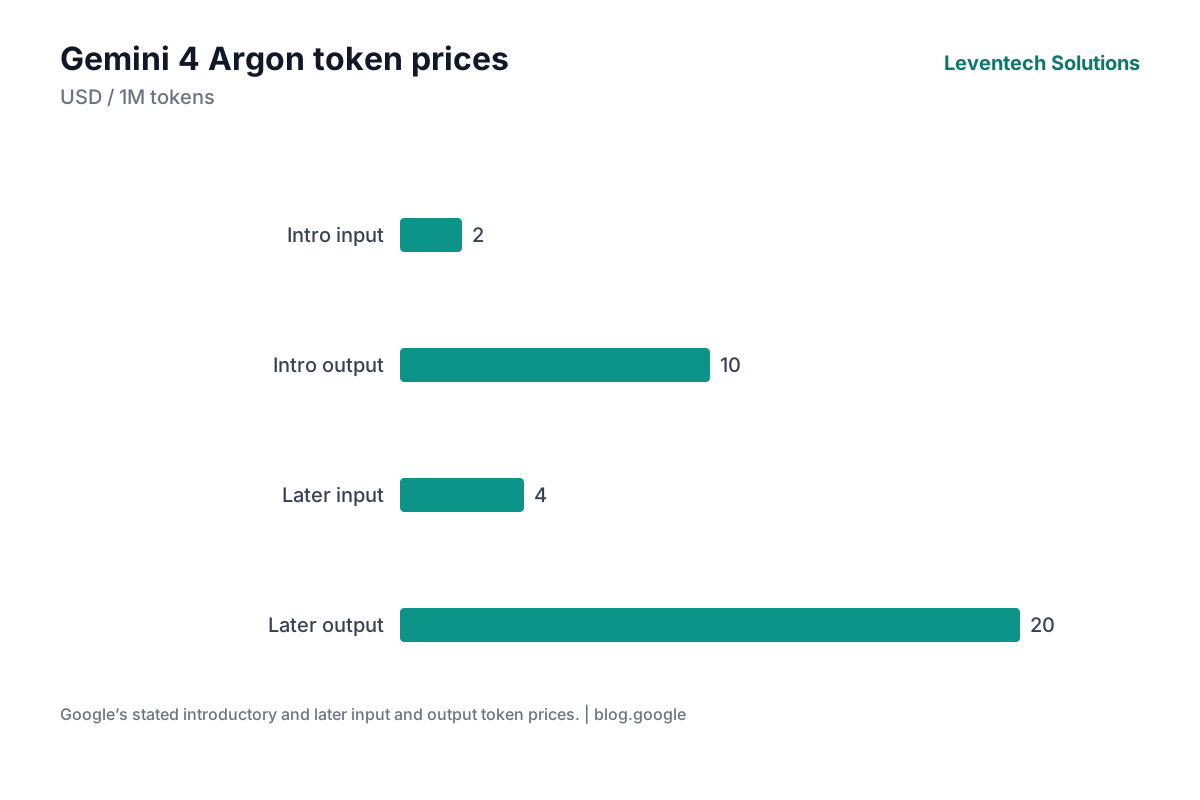 Open full-size chart
Chart data as a table
| Gemini 4 Argon token prices | USD / 1M tokens |
|---|---|
| Intro input | 2 |
| Intro output | 10 |
| Later input | 4 |
| Later output | 20 |